Maximum precision, greater consistency and a world of colors and finishes to explore.

MIYUKI manufactures an extraordinarily broad catalog of glass seed beads in Japan, with thousands of combinations of shapes, sizes, colors and finishes.
For us, one characteristic becomes especially important when we incorporate them into knitting and crochet: the consistency of each bead.
MIYUKI seed beads are known for highly precise manufacturing and exceptional dimensional consistency. In the language commonly used in the bead world, we refer to them as calibrated: within the same reference, the beads maintain much more consistent shape and dimensions than those typically found in many generic seed beads.
This may seem like a small detail, but it makes a significant difference in textile work.
When beads become part of the fabric, calibration matters.
When dozens or hundreds of beads are repeated throughout a garment, small size differences begin to accumulate. MIYUKI’s consistency helps maintain even tension and makes the final result more predictable.
That is why at Budetex we do not try to reproduce MIYUKI’s enormous catalog. We make a selection specifically focused on hand knitting, crochet and textile applications.
We are especially interested in shapes and sizes whose inner hole diameter allows practical use with yarns, fine crochet hooks and different bead-placement techniques.
CONTACT BUDETEX ABOUT MIYUKIIn an isolated decorative application, a small difference between one bead and another may go almost unnoticed.
In knitted or crocheted fabric, something different happens: each bead becomes part of the repetitive structure of the surface.
If a group of beads varies too much in diameter, thickness or weight, it can affect stitch tension, change spacing or create a visually irregular surface.
MIYUKI’s high degree of consistency provides a much more reliable reference.
Consistently sized beads interact with stitches more predictably and help maintain more even tension.
When a pattern uses hundreds of beads, calibrated shapes provide greater consistency from one repeat to the next.
The swatch becomes a more reliable reference for anticipating how the full design will behave.
Lines, motifs and bead distributions look more orderly when the pieces maintain consistent dimensions.
This precision and uniformity are among the qualities that have made MIYUKI an international reference in the world of seed beads.
Calibration gives us consistency. But to know whether a bead works with a particular technique, we need to look at another dimension: the inner hole diameter.
That diameter determines which tools can pass through the bead and, with pre-stringing techniques, which yarns can pass through it.
Two beads with similar outer dimensions can have different hole sizes. And two yarns with the same nominal weight can compress very differently.
MIYUKI publishes technical reference dimensions for its different families, allowing us to relate more precisely bead + yarn + tool.
At Budetex, we aim to build a broad selection from each brand and maintain continuity over time, with regular restocking for both retail and wholesale.
El catálogo de MIYUKI is extraordinarily broad, with thousands of combinations of shapes, sizes, colors and finishes. That is why our selection for Argentina is especially focused on beads we consider most useful for textile applications, hand knitting and crochet.
We currently work mainly with Round Rocailles 6/0, Triangle y Square, prioritizing sizes with good dimensional consistency and sufficiently large holes for use with different techniques, yarns and tools.
Dentro de las Round Rocailles 6/0 we also aim to offer a particularly broad variety of colors and finishes, because with this type of product the ability to combine shades and finishes is central to design.
We do not try to reproduce MIYUKI’s entire catalog in Argentina. Our goal is to build a meaningful selection for textile work, keep it available and expand it progressively as we learn which shapes, sizes and finishes are most useful to our community.
Is there a MIYUKI shape, size or color we do not currently carry that you would like to find in Argentina? Contact us. We take these requests into account when planning future imports.
For wholesale sales to specialty retailers, we can also evaluate MIYUKI references that are not part of our regular selection.
This table summarizes only the families and sizes we consider especially useful for textile applications.
In addition to outer and inner dimensions, we include an approximate bead count for the pack sizes we commonly use at Budetex.
| Family | Code | Size | Approx. outer size | Approx. hole size | Approx. pieces |
|---|---|---|---|---|---|
| Round Rocailles | RR | 8/0 | 3,0 mm | 1,1 mm | ≈ 780 / 20 g |
| Round Rocailles | RR | 6/0 | 4,5 mm | 1,5 mm | ≈ 240 / 20 g |
| Round Rocailles | RR | 5/0 | 5,0 mm | 2,0 mm | ≈ 144 / 20 g |
| Round Rocailles | RR | 1/0 | 6,5 mm | 2,4 mm | ≈ 66 / 20 g |
| Triangle | TR | 8/0 | 3,0 mm | 1,1 mm | ≈ 215 / 7 g |
| Triangle | TR | 5/0 | 4,5 mm | 1,5 mm | ≈ 77 / 7 g |
| Sharp Triangle | STR | 8/0 | 2,6 mm | 1,0 mm | ≈ 341 / 7 g |
| Sharp Triangle | STR | 5/0 | 4,2 mm | 1,3 mm | ≈ 82 / 7 g |
| Square | SB | 3 mm | 3 × 3 × 3 mm | 1,3 mm | ≈ 420 / 20 g |
| Square | SB | 4 mm | 4 × 4 × 4 mm | 1,4 mm | ≈ 214 / 20 g |
| Delica | DBM | 10/0 | 2,2 mm | 1,0 mm | ≈ 2.160 / 20 g |
| Delica | DBL | 8/0 | 3,0 mm | 1,5 mm | ≈ 600 / 20 g |
Dimensions correspond to technical reference values published by MIYUKI. Bead counts per tube are estimates calculated from the approximate number of pieces per kilogram indicated by the manufacturer. Weight may vary slightly depending on glass type, color and surface treatment.
Triangle and Sharp Triangle are not the same.
MIYUKI identifies Triangle as TR and Sharp Triangle as STR. Both have a triangular cross-section, but Triangle has more rounded corners and different dimensions.
At Budetex, our MIYUKI selection is sold exclusively in smaller, repacked tubes.
The goal is to make it possible to choose a much wider variety of colors and finishes without having to buy considerably larger packs.
20 g
Our usual presentation for Round 6/0.
20 g
Our usual presentation for Square.
7 g
Our usual presentation for Triangle.
The number of beads per tube is always approximate. Different glass types, colors and coatings can slightly change the individual weight of each bead.
Shape is not only an aesthetic matter. It changes how the bead integrates with the stitch, reflects light and creates texture across the surface.
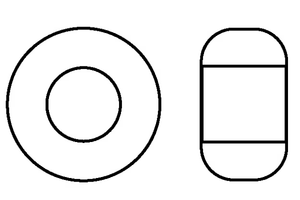
The most versatile shape to start with.
The rounded geometry creates small points of light without imposing a strong directional effect on the fabric.
At Budetex, we work especially with Round 6/0: approximately 4.5 mm outer diameter and a 1.5 mm inner hole.
Its calibration, scale and hole size make it our first recommendation for adding beads to garments, shawls, edges and lace.
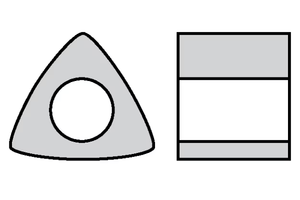
Facets, volume and movement.
Its triangular cross-section makes each face reflect light from a different angle.
Our Sharp Triangle 5/0 measures approximately 4.5 mm and has an inner hole close to 1.5 mm.
We would use it when we want the bead to contribute not only color or shine, but also a more dynamic visual texture.
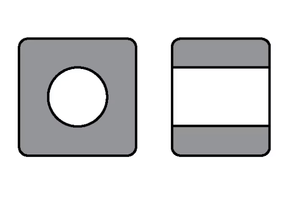
A more graphic, defined geometry.
Square replaces the rounded surface with flat faces that catch light from different angles.
The Square 4 mm currently in our selection has an approximate inner hole of 1.4 mm.
We especially like it for geometric designs, lines, borders and combinations with Round.

Consistency taken even further.
Delica is one of MIYUKI’s best-known families. Its extremely consistent cylindrical geometry allows the beads to sit next to one another with great precision.
For textile applications, we would look especially at DBM 10/0 and DBL 8/0, with approximate hole sizes of 1.0 and 1.5 mm respectively.
It is particularly interesting when we want precision, repeatability and a highly ordered visual surface.
MIYUKI offers an enormous range of colors, glass types, coatings and surface treatments.
En nuestra colección Round Rocailles 6/0 we carry an especially broad variety. To make the selection easier to browse, we organize it into visual families, grouping references mainly by their predominant external appearance.
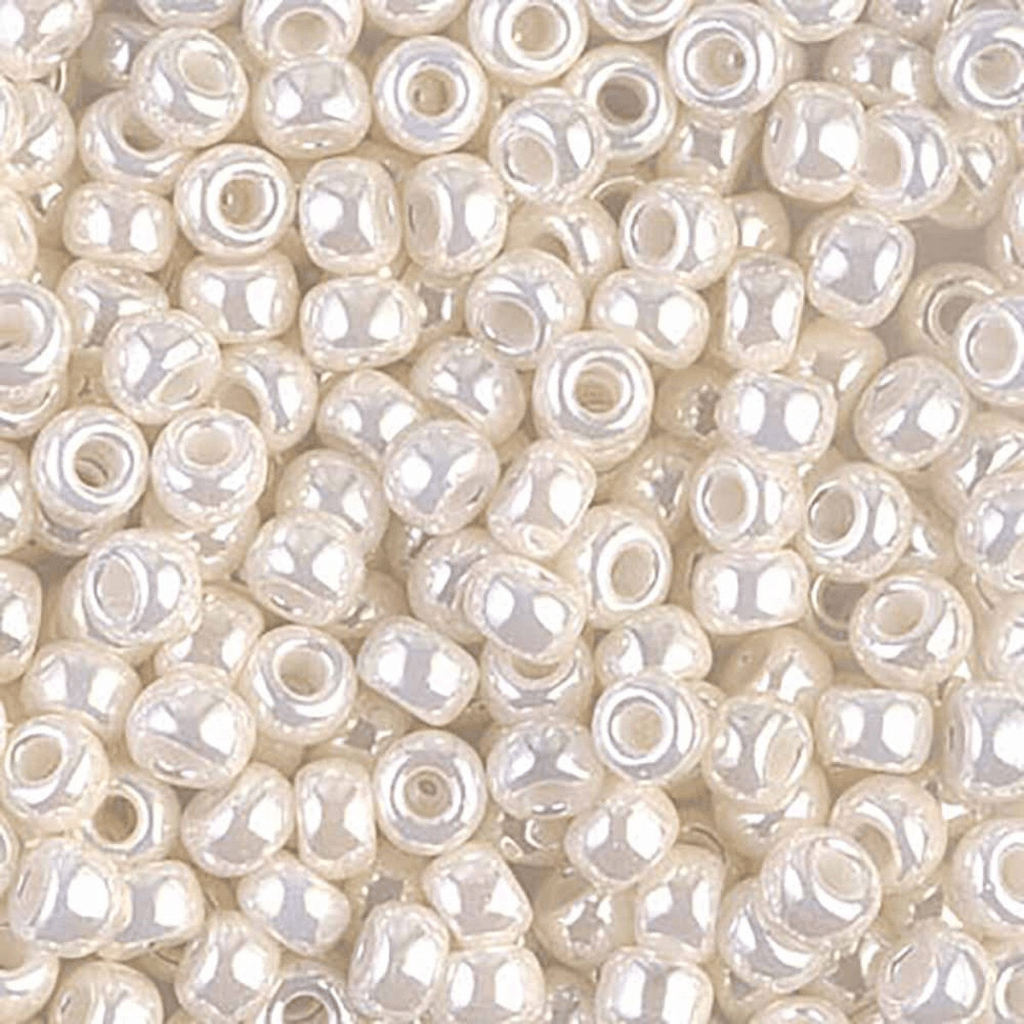
Finishes with soft luster and depth that add small points of light to the fabric.
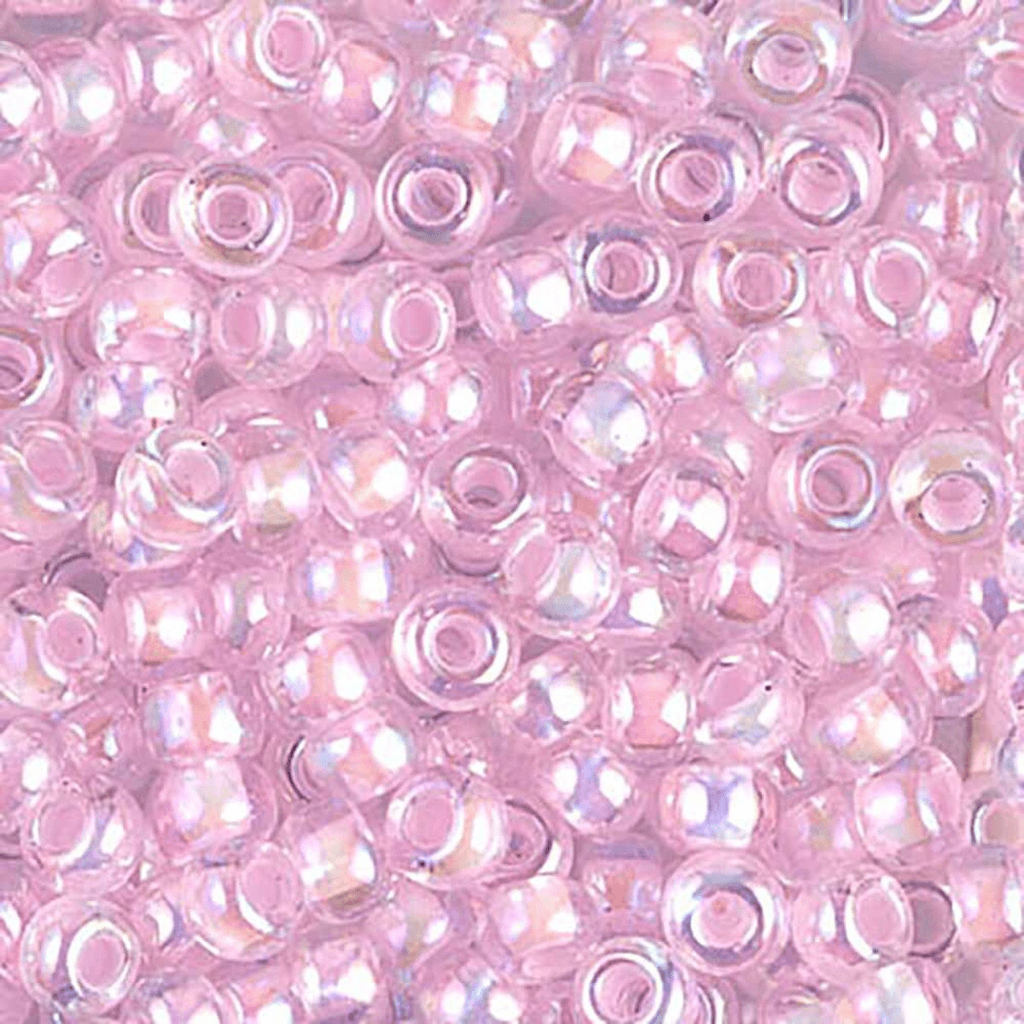
The glass allows light to pass through, creating transparency, depth and color effects.
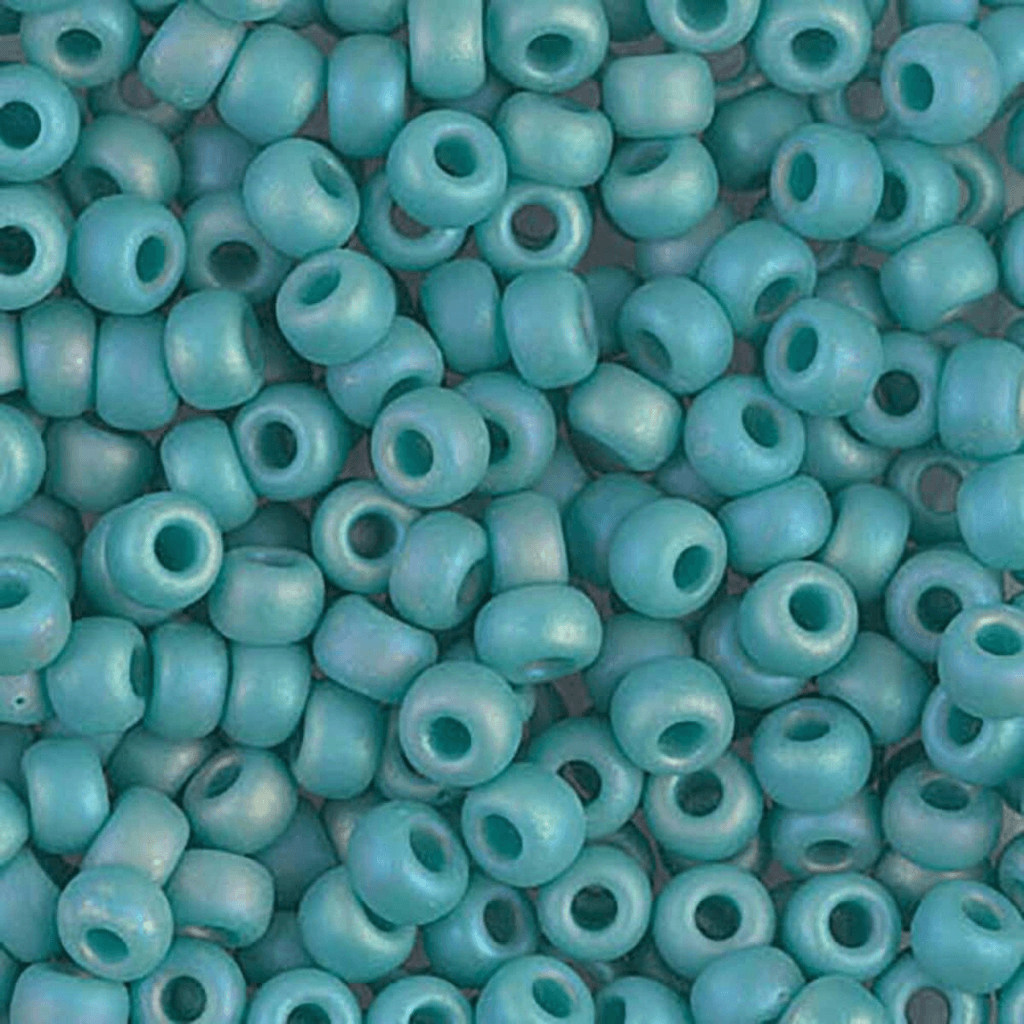
Low-luster surfaces for a quieter effect and less reflective presence.
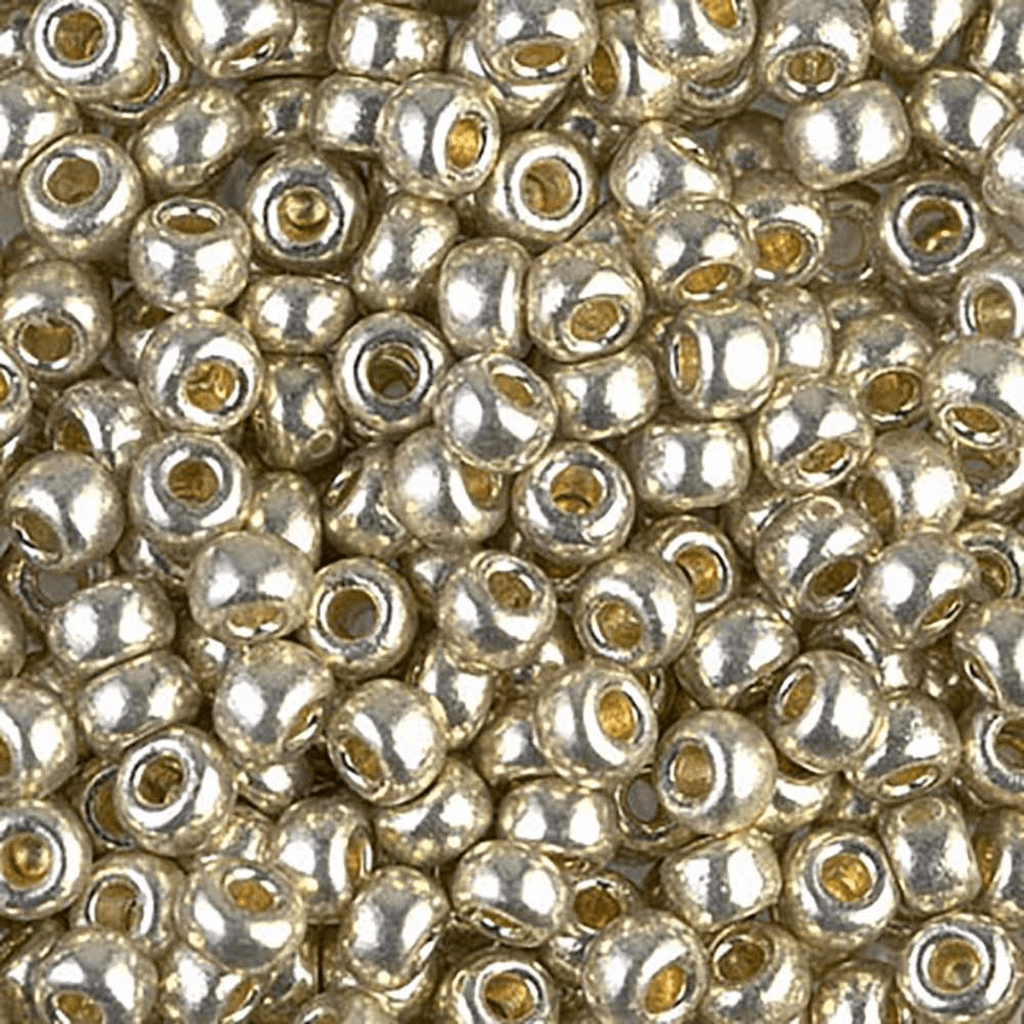
Metallic-looking finishes that create stronger reflections and pronounced contrast against the fiber.
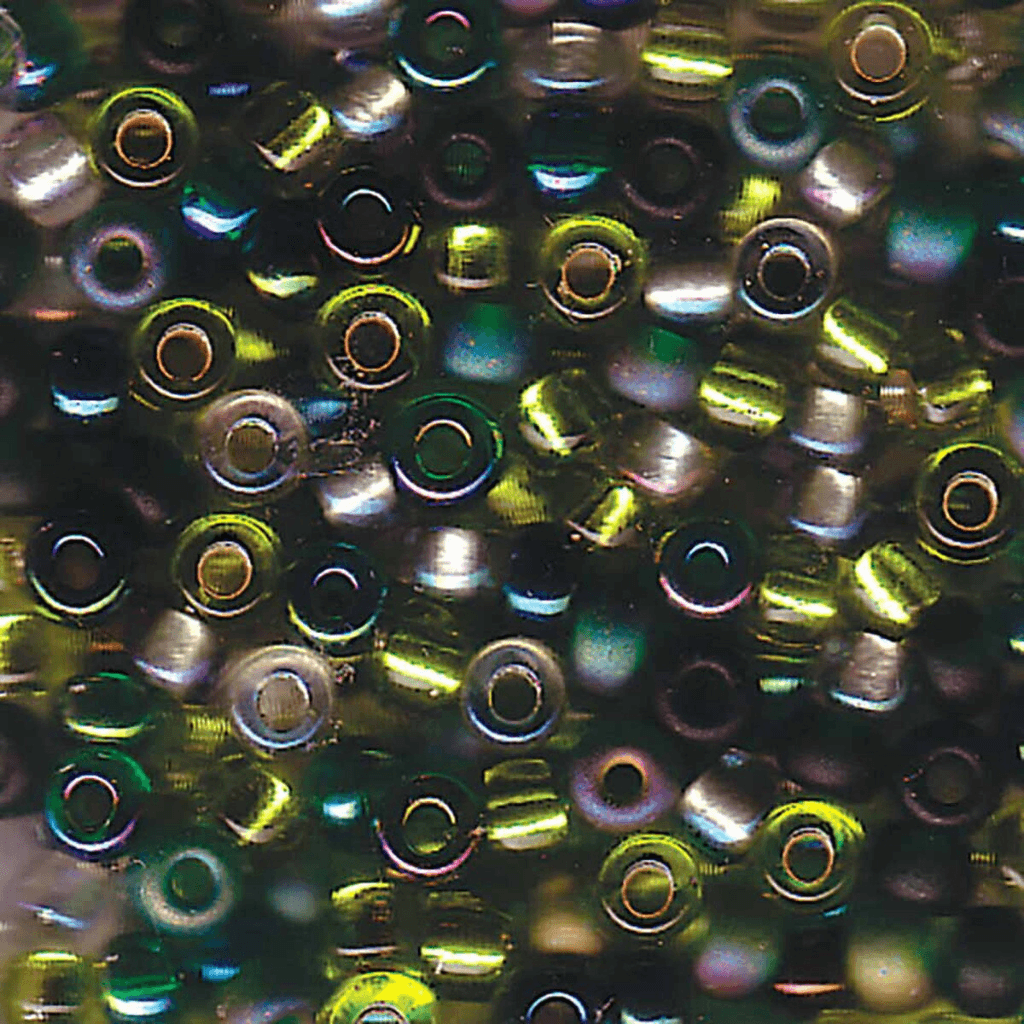
Combinations of different colors and finishes that introduce variation directly through the bead selection.
A simpler way to browse an enormous collection.
This organization is a Budetex visual and commercial classification, created to make choosing within our selection easier. It does not replace or attempt to reproduce MIYUKI’s official technical classification.
Duracoat® does not identify a bead shape or a single visual appearance.
It is a treatment developed by MIYUKI that applies a special coating to selected surface finishes to increase resistance to friction and color loss.
That is why Duracoat beads can have very different colors and appearances.
At Budetex, we group them into one category because when beads are incorporated into garments, the finish’s resistance to friction and wear becomes particularly important.
This does not mean they are indestructible or that any finish can be exposed indefinitely to washing, friction or chemicals. MIYUKI itself explains that Duracoat improves resistance but does not completely eliminate the possibility of wear.
Adding beads to textile work does not depend on the type of needle or technique used to construct the garment.
They can be used in projects made with circular needles, straight needles, double-pointed needles and crochet, as well as added afterward through embroidery or other textile techniques.
The main tools construct the fabric. The method used to add the bead is a separate decision.
Beads can be incorporated in circular or flat knitting, in garments, shawls, accessories and other projects.
The technique works equally well in flat knitting made with straight needles.
They can also be incorporated into small circumferences worked with double-pointed needles.
Beads can be integrated directly into many crochet stitches and constructions.
That is why, when we talk about MIYUKI for textile work, we are not referring to one technique. We are talking about incorporating a calibrated glass bead into a textile structure, regardless of the main tool used to build it.
There are different ways to work with beads. The chosen technique changes both the tool required and the relationship between hole diameter and yarn.
In any of these techniques, calibrated beads help make tension, spacing between beads and the visual result more predictable.
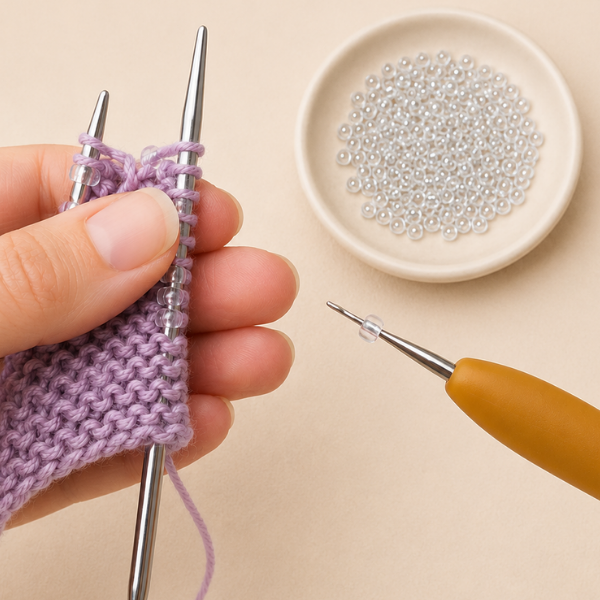
A very fine crochet hook passes through the bead, catches the selected stitch and pulls it through the hole.
Advantage: each bead can be added exactly where needed, without pre-stringing all the beads onto the yarn.
This technique is especially useful for localized motifs, shawls, lace and patterns where each bead has a specific position.
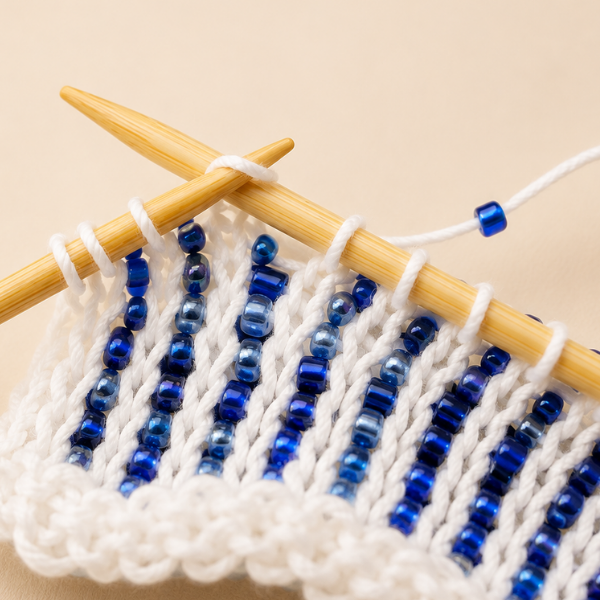
Before starting, the beads are threaded onto the yarn in the required quantity or sequence.
During the work, they are moved along the yarn to the required position.
Here, the inner hole diameter becomes critical: the yarn itself must pass through the hole without being damaged.
In repetitive patterns, calibration is especially useful: a sequence of consistently sized beads creates a much more uniform result.
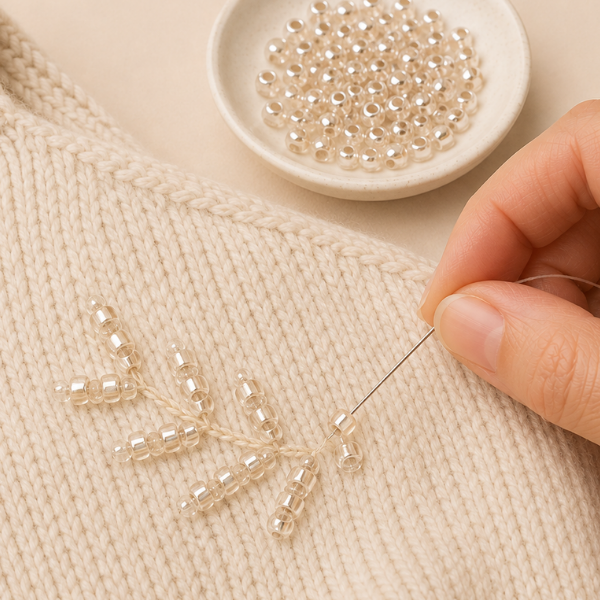
Beads can also be added after the fabric is finished through sewing or embroidery.
This method gives precise control over final placement and allows the use of beads whose hole might be too small for the full yarn to pass through.
Even with this technique, calibrated beads help maintain more consistent spacing, alignment and motifs.
With the stitch-by-stitch placement technique, the crochet hook must physically pass through the bead.
That is why the inner hole diameter gives us a first way to select the tool.
We do not recommend using a crochet hook with the same nominal diameter as the hole. We need clearance for the geometry of the hook head to pass through as well.
| Approx. hole size | Crochet hook we would try first |
|---|---|
| 1,0 mm | 0,50–0,60 mm |
| 1,1 mm | 0,50–0,75 mm |
| 1,3 mm | 0,75–0,90 mm |
| 1,4–1,5 mm | 0,90–1,00 mm |
| 2.0 mm or more | 1.00–1.25 mm as a starting point |
This table reflects Budetex’s editorial recommendation, not a MIYUKI specification. Hook-head shape also matters, so we always recommend testing the combination before starting a complete project.
Calibration + inner hole diameter + the right tool: those are the three variables we would look at before choosing color.
This is one of the most important questions when adding beads to textile work, but the answer first depends on how we plan to place them.
If we are going to pre-string the beads onto the yarn, the entire yarn must pass through the hole. In that case, the bead’s inner diameter directly determines which yarn thicknesses can be used.
If, instead, we place each bead stitch by stitch with a fine crochet hook, the yarn itself does not need to pass completely through the hole. The tool passes through the bead, catches the stitch and pulls it through. This considerably expands the possibilities.
The same bead can work with very different yarns.
The first thing to define is not only yarn thickness, but the technique we will use to incorporate the bead.
As a general guide, the yarn should be noticeably finer than the bead’s inner hole diameter. We need enough clearance for it to pass through without forcing, damaging or creating excessive friction.
| Inner hole | Yarn we would try first |
|---|---|
| 1,0–1,1 mm | Lace and very fine yarns |
| 1,3 mm | Lace / fine Fingering |
| 1,4–1,5 mm | Lace / Fingering / some fine Sport |
| 2,0 mm | Fingering / Sport / some compressible DK |
| 2,4 mm | Sport / DK and some thicker yarns |
These equivalences are approximate. A commercial yarn-weight label does not tell the whole story. Construction, ply count, twist, fiber, elasticity and compressibility also determine whether a yarn can pass through a bead.
A merino yarn, a compact cotton and a mohair may be classified within a similar yarn weight and still behave completely differently when passed through the same hole.
That is why we always recommend testing with the actual yarn and bead before calculating quantities for a complete project.
Important: if the yarn does not pass comfortably through the bead, that does not necessarily mean the combination cannot be used. Stitch-by-stitch placement with a fine crochet hook may allow the same bead to be added without pre-stringing.
| If you are looking for... | Start with... |
|---|---|
| Your first experience with beads | Round 6/0 |
| Maximum versatility | Round 6/0 |
| A more understated visual effect | Round Matte |
| Points of light | Round Pearl / bright finishes |
| Prioritize finish durability | Duracoat |
| A graphic effect | Square 4 mm |
| Facets and movement | Triangle 5/0 |
| A more complex surface | Combine different geometries |
This table reflects Budetex’s editorial recommendation. The project, yarn, technique and intended effect may change the choice.
Beads can act as small points of light or become a fundamental part of a garment’s visual construction.
To show some of these possibilities, we include work by Pope Vergara, a Chilean designer specializing in incorporating beads into knitted fabric and an important practitioner of this technique in the region.
Her designs show something a technical sheet cannot fully explain: how fiber, stitch, tension, color and glass interact when the bead stops being an added ornament and becomes part of the design.



Designs by Pope Vergara. Photographs reproduced with permission.
Within our current selection, Round Rocailles 6/0 is the starting point we recommend for discovering the possibilities of adding beads to textile work.
Its approximate 4.5 mm size gives it presence without becoming overly dominant, while its hole of around 1.5 mm works with an interesting range of tools and techniques.
But there is a third characteristic that is especially important for beginners: its consistency.
When learning to control the relationship between yarn, stitch and bead, working with calibrated pieces removes an unnecessary variable. Once the correct tension is established in a swatch, it can be repeated much more predictably throughout the project.
If you have never worked beads into your knitting or crochet: we would start with a Round 6/0, a compatible fine crochet hook and a small swatch before adding them to a complete garment.

MIYUKI is a Japanese manufacturer specializing in high-precision glass seed beads.
Its catalog includes an enormous variety of shapes, sizes and finishes, from traditional Round Rocailles to specific geometric families such as Delica, Triangle, Sharp Triangle, Square, Tila, Drop and many others.
What interests us most about MIYUKI for textile applications is the combination of:
Calibration is particularly important: in a knitted or crocheted design, we are not working with a single bead but with dozens or hundreds of them. Consistency between beads ultimately becomes part of the quality of the final result.
We do not aim to carry every reference MIYUKI manufactures.
We aim to understand the catalog and select the beads that genuinely expand the possibilities of textile work.
It means that beads from the same reference show a high degree of consistency in shape and dimensions. MIYUKI is internationally recognized precisely for the uniformity of its seed beads.
Because each bead interacts with a stitch. When the beads maintain similar dimensions, tension, spacing and weight repeat more consistently, making the result more uniform and predictable.
A small isolated variation may be imperceptible. But if a design uses dozens or hundreds of beads, repeated size differences can alter tension, alignment and surface appearance. Calibrated beads reduce those variations considerably.
No. Calibrated does not mean every bead is mathematically identical. It means they are manufactured to a high degree of consistency. MIYUKI also notes that published technical dimensions are approximate and may vary slightly by lot and measuring conditions.
It is a traditional nomenclature used to indicate the size of certain seed beads. As a general rule, the larger the number before /0, the smaller the bead. An 8/0, for example, is smaller than a 6/0.
MIYUKI’s technical reference indicates approximately 4.5 mm outer diameter and 1.5 mm inner diameter.
Using MIYUKI’s average weight reference, approximately 240 beads. The actual quantity may vary depending on glass, color and surface treatment.
Because it determines which tools can pass through the bead and which yarns can pass through it when using pre-stringing techniques.
Round 6/0. It combines a generous hole, an easy-to-handle size, a broad range of colors and the dimensional consistency that helps when learning to control tension.
No. MIYUKI identifies them as different families. Triangle uses the TR designation and Sharp Triangle uses STR. Sharp Triangle has more pronounced corners and different dimensions.
It is a treatment developed by MIYUKI to increase the resistance of certain surface finishes to friction and wear. It does not describe a shape or one specific visual appearance.
No. MIYUKI states that the treatment increases resistance but does not guarantee that the finish is completely immune to friction, use or certain cleaning conditions.
Not necessarily. At Budetex, we also use our own visual classification to make browsing our broad Round 6/0 selection easier. This commercial organization does not replace MIYUKI’s technical nomenclature.
We first look at the inner hole diameter and choose a noticeably smaller tool, leaving clearance for the hook-head geometry. We always recommend testing before beginning the project.
No. It depends on the inner hole diameter, yarn thickness, construction and compressibility. Two apparently similar yarns can behave very differently.
No. Our selection is sold exclusively in smaller repacked tubes, generally 20 g. Triangle is currently presented in 7 g tubes.
A seed bead may seem like a tiny detail.
But once it becomes part of a textile structure, several characteristics begin to matter: consistency, shape, weight, inner hole diameter, color, finish and relationship with the fiber.
That is why our selection does not begin with color.
First we look for a consistent bead. Then we consider what it can contribute to the fabric.


